

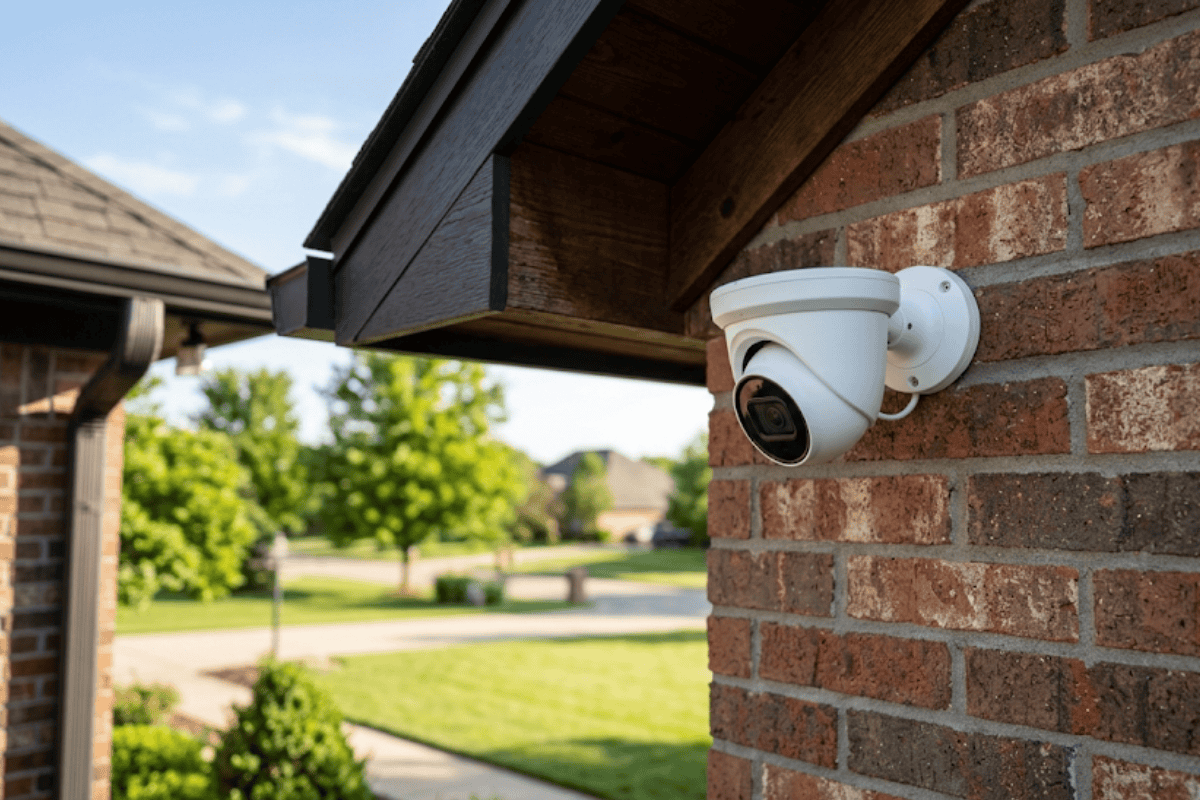
21 Sep Do I Need a Permit to Install Security Cameras in Oklahoma?
Most homeowners in Tulsa, Oklahoma can mount a standard security camera on their house this weekend without filing a single form at City Hall. That said, the honest answer to do I need a permit to install security cameras in Oklahoma isn’t a flat yes or no, because the exemption that covers ordinary residential cameras narrows fast once electrical work, pole mounting, commercial property, or an HOA covenant enters the picture. For most single-family homes in Tulsa, Broken Arrow, Jenks, Bixby, Owasso, and Sand Springs, a wall-mounted camera plugged into existing power is not a permitted activity at all. It’s the exceptions, not the rule, that trip people up.
This post walks through what actually triggers a permit conversation in the Tulsa metro, what falls under HOA rules instead of city rules, and where Oklahoma’s privacy law comes into play regardless of permits.
The Short Answer for Most Homes
Oklahoma does not have a statewide permit requirement specifically for installing security cameras. Camera hardware itself, whether it’s a doorbell camera, a wired dome camera under an eave, or a battery-powered unit on a fence post, is not treated as a regulated structure or a licensed trade in the way electrical panels, gas lines, or load-bearing walls are. If you’re simply adding a camera to an existing outlet or running low-voltage cable to a recorder inside the house, a permit is not typically required by city permitting offices in Tulsa and the surrounding suburbs.
That baseline answer changes once the installation stops being “just a camera” and starts touching things a city does regulate.
When a City Permit Actually Applies
City and county permitting in Oklahoma is built around specific categories of work, not around the finished product sitting on your wall. A handful of situations reliably pull a camera installation into permit territory:
- New electrical circuits or panel work. If the installer needs to add a dedicated circuit, run new line-voltage wiring, or open a breaker panel to power cameras or a monitoring system, that’s licensed electrical work, and Tulsa’s own residential permitting guidance is explicit that electrical permits can only be obtained by licensed contractors.
- Structural mounting or exterior modifications. Cutting into a roofline, adding a new pole, or modifying siding or masonry to seat a camera can cross into building-permit territory depending on scope.
- Poles or hardware placed in the public right-of-way. A camera pole set in the strip between a sidewalk and the street, or attached to a utility pole, involves land the city controls, not your property, and that’s a right-of-way question entirely separate from “installing a camera.”
- Commercial buildings tied into fire, life-safety, or shared electrical systems. Multi-tenant buildings and larger commercial sites are more likely to require documentation because the work touches infrastructure other tenants or code officials also rely on.
- Historic districts or designated overlay zones. A small number of neighborhoods carry additional design-review layers that can apply to visible exterior equipment.
If your project doesn’t involve any of the above, it’s reasonable to expect no city permit is required. If it involves even one, that’s the point to call the local permit center before scheduling installation, since guides like Tulsa’s permit center and Broken Arrow’s permitting office handle electrical and building permits case by case rather than publishing a blanket rule for cameras.
Do You Need a Permit to Install Security Cameras in an HOA Community?
Here’s where the answer to do you need a permit to install security cameras in an HOA community gets confusing for a lot of homeowners: an HOA approval is not a government permit, but it can function like one in practice. Oklahoma homeowners associations operate under private governing documents, generally organized through the state’s law on owners associations, and that gives boards real authority to require review of exterior changes, including cameras, wiring, and mounting brackets.
Requirements vary enormously from one community to the next. Some Tulsa-area HOAs only care about visible wiring or camera color; others require a written request before any exterior device goes up, regardless of whether it needs a city permit at all. Because this is a contractual matter between homeowner and association rather than a city ordinance, there’s no single answer that covers every gated subdivision from Jenks to Owasso. Reading your covenants, or simply asking the HOA board directly, is the only reliable way to know before you buy equipment.
Permit Likely Needed? A Quick Reference
The table below summarizes how each common scenario typically plays out. Every line matches what’s discussed above and below, so you can use it as a quick gut check before you start.
| Scenario | Permit Typically Required? | Why |
|---|---|---|
| Single-family home, camera on existing outlet, no structural changes | Not typically | Neither Oklahoma law nor local building guidance treats camera hardware itself as a regulated permit item. |
| New electrical circuit added to power the system | Yes | Licensed electrical work requires an electrical permit regardless of what the circuit ultimately powers. |
| HOA-governed property | Depends, check HOA first | This is a private covenant matter, not a city permit, and rules vary widely by association. |
| Commercial building exterior installation | Often yes, confirm with city | Commercial work more often ties into shared electrical or life-safety systems that require documentation. |
| Pole-mounted camera in the public right-of-way | Yes | Placing any structure in city-controlled right-of-way requires separate authorization from the city. |
| Camera incidentally capturing a sidewalk or neighbor’s yard | No permit, but legal risk | Not a permitting issue at all, but Oklahoma’s unlawful surveillance law restricts intentionally targeting areas with a reasonable expectation of privacy. |
Alarm Permits Are a Different Requirement Entirely
One source of real confusion: several cities in the Tulsa area require a separate alarm permit or registration, and that has nothing to do with cameras specifically. Tulsa requires monitored intrusion alarm users to file for an alarm permit, a $35 residential or $75 commercial registration renewed annually so police and fire dispatch know who to contact. Broken Arrow issues its own alarm permits through its permitting office, and Owasso requires fee-based alarm registration for both residential and commercial alarm users under its own ordinance. None of these apply to a passive, recording-only camera system that isn’t tied to a monitored alarm panel, but if your project bundles cameras with a monitored alarm, budget time for that separate paperwork.
Camera Placement, Privacy, and Oklahoma Law
Even where no permit applies, Oklahoma’s unlawful surveillance law still governs where a camera can point. That statute treats intentionally recording someone in a place where they have a reasonable expectation of privacy, such as through a neighbor’s window or into a fenced backyard, as a criminal matter rather than a civil nuisance. Ordinary overlap, like a driveway camera also catching a slice of the street or a neighbor’s front yard, isn’t the concern; deliberately aiming a lens at private space is. Getting placement right the first time avoids both a permit headache and a legal one, which is exactly the kind of judgment call a proper site walk-through resolves before installation day rather than after.
Why Choose Tulsa Surveillance Technologies
Tulsa Surveillance Technologies installs cameras, access control, and alarm systems across six different permitting jurisdictions: Tulsa, Broken Arrow, Jenks, Bixby, Owasso, and Sand Springs, and no two of them handle alarm registration, electrical permitting, or HOA-adjacent questions in quite the same way. A camera install on a gated Jenks subdivision’s exterior raises different HOA-approval questions than the same job on a Sand Springs storefront, and a pole-mounted parking-lot camera in Owasso runs into right-of-way and alarm-registration rules that a Broken Arrow ranch home never will.
Working routinely across all six cities means knowing which permit office to call, and which questions an HOA board typically asks, before a technician ever shows up with a ladder. Tulsa Surveillance Technologies holds Oklahoma license AC440731, and part of planning any installation is flagging early whether your specific address, building type, or HOA is the kind that’s likely to need a permit conversation or an architectural approval letter first. That’s a matter of knowing the local map, not a credential you can shortcut.
If your project touches an HOA covenant, a commercial electrical panel, or right-of-way work, call Tulsa Surveillance Technologies before you buy any equipment. A short conversation up front is faster than reworking a permit application after the fact.
Getting Your Installation Right the First Time
A proper security assessment is where permit questions actually get answered, because it identifies exactly what your camera plan requires before anyone touches a wall. Before that visit, it helps to have a few things ready:
- Your property address and city, since permitting and HOA rules differ block to block
- Whether your property is governed by an HOA, and a copy of any architectural-review requirements if so
- Whether you’re expecting new electrical work, such as adding outlets or a dedicated circuit
- How many cameras you want, and roughly where, including any pole or right-of-way locations
- Your timeline, especially if a permit or HOA approval could add a few weeks
Once that’s mapped out, the installation process itself moves quickly, because the permit and approval questions were already answered instead of discovered midway through a job.
Conclusion
For the large majority of homes in Tulsa, Broken Arrow, Jenks, Bixby, Owasso, and Sand Springs, installing security cameras doesn’t require a city permit at all. The exceptions are specific and knowable: new electrical circuits, structural mounting, commercial buildings, right-of-way placement, and HOA architectural review, which is a private matter separate from any government permit. Alarm registration is its own requirement in several of these cities, distinct from camera installation itself, and Oklahoma’s privacy law shapes where a camera can point regardless of any permit question. Working through those categories before installation day, rather than during it, is what keeps a straightforward camera project from turning into a paperwork problem.
Not sure whether your project needs a permit? Schedule a consultation with Tulsa Surveillance Technologies and get a straight answer before you buy anything.
Frequently Asked Questions
Do I need a permit to install security cameras in Oklahoma?
In most cases, no. Oklahoma has no statewide permit requirement for mounting standard security cameras, and the camera itself doesn’t trigger city permitting. Permits typically apply only when installation involves new electrical wiring, structural changes, or equipment in a public right-of-way.
Does an HOA need to approve security cameras?
Many Oklahoma HOAs require an architectural request before mounting exterior equipment, including cameras, even though this isn’t a government permit. Requirements vary widely by community, covering placement, wiring, and device appearance. Checking your covenants first avoids disputes later.
Can a neighbor legally point a security camera at my house?
Generally yes, if the camera captures ordinary exterior views like a driveway or front yard visible from public space. It’s a legal problem only if the camera intentionally targets a space with a reasonable expectation of privacy, such as a bedroom window or fenced backyard. Oklahoma’s unlawful surveillance law addresses that narrower situation, not casual overlap between properties.
Do commercial security camera installations require a permit in Tulsa?
Commercial installations more often involve licensed electrical work or tie-ins to a building’s power panel, either of which can require a permit under city codes. Camera-only work using existing power and low-voltage cabling often doesn’t need one. Confirming scope with the city’s permitting office beforehand is the safest approach.
Do I need an electrical permit to install security cameras?
Only if the work is reserved for licensed electricians, such as adding a new circuit or modifying a breaker panel. Plugging a camera into an existing outlet or running low-voltage cable typically falls outside that requirement. When in doubt, ask your installer whether the job involves licensed electrical work.
Sorry, the comment form is closed at this time.