

14 Sep Indoor vs Outdoor Security Cameras: What’s the Difference?
A camera labeled “weather-resistant” on the retail box is not automatically safe to mount above a garage door in Broken Arrow or Bixby, and Oklahoma’s weather makes that assumption an expensive one. Many homeowners and business owners across Tulsa treat security cameras as interchangeable, mounting whatever unit was on sale wherever a mounting bracket happens to fit. That mix-up is where the indoor vs outdoor security cameras question, and what’s the difference between the two, actually starts: it is not about the picture quality on a phone screen, it is about how each camera is engineered to survive the environment it’s placed in, from the housing material and lens seal to how it handles glare, humidity, and total darkness. Get that pairing wrong in Oklahoma, where summer afternoons regularly push past 100 degrees and a single ice storm can coat a housing in glaze overnight, and a camera can fail well before it should.
Indoor vs Outdoor Security Cameras: The Core Technical Differences
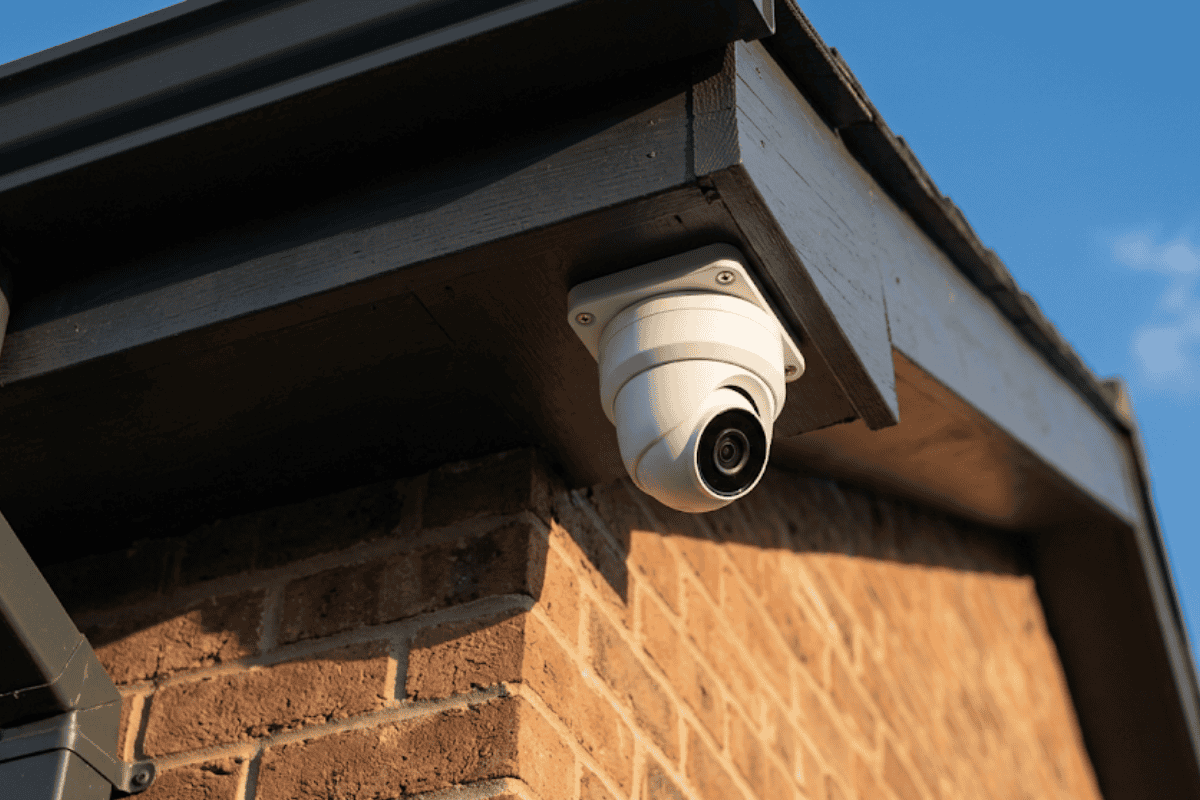
The most visible difference between the two camera types is the housing, but the housing is really just packaging for a longer list of internal choices. Outdoor cameras use sealed, often metal or reinforced-polycarbonate enclosures built to keep out dust, insects, and driving rain, while indoor cameras typically use lighter plastic housings that were never designed to handle standing water or temperature swings. That sealing level is measured with an ingress protection, or IP, rating: a two-digit code where the first number rates resistance to dust and the second rates resistance to water. The National Electrical Manufacturers Association publishes a parallel enclosure rating system used across the electrical industry, and it notes that enclosure ratings also account for icing and corrosion resistance, both of which matter far more in Oklahoma than in a mild coastal climate.
Lens type and internal optics differ too. Indoor cameras are usually tuned for a narrower brightness range because indoor lighting is fairly consistent, while outdoor cameras need wide dynamic range processing to handle direct sun, headlight glare at night, and deep shadow all in the same frame. Whatever the location, both camera types stream footage over a home or business network, and the Federal Trade Commission recommends keeping camera firmware updated and using strong, unique passwords regardless of whether the unit is mounted in a hallway or bolted to a soffit, since an unsecured camera is a target no matter where it lives.
| Feature | Indoor Camera | Outdoor Camera |
|---|---|---|
| Weatherproof/IP rating | None required, often unrated or IP20 | Typically IP66 or higher |
| Typical placement | Hallways, living rooms, nurseries, retail counters | Eaves, entry doors, driveways, parking areas |
| Lighting needs | Consistent indoor lighting, limited glare | Wide dynamic range for sun glare, infrared for total darkness |
| Operating temperature range | Roughly 32°F to 104°F, standard indoor comfort range | Commonly rated down to about -22°F and up to 140°F |
| Common use case | Watching children, pets, or a cash register | Monitoring a perimeter, driveway, or building exterior |
Every figure in that table matters more once you factor in where the camera is going. An indoor camera left unrated or rated only IP20 has no meaningful defense against water, which is exactly why it belongs in a hallway or nursery and not above a back porch in Jenks. An outdoor camera rated IP66 or higher, by contrast, is built to shrug off wind-driven rain and dust, and models rated down to roughly -22°F and up to 140°F are built specifically for climates that swing as hard as ours does.
How Oklahoma’s Climate Changes the Calculus
Tulsa doesn’t get a mild, predictable climate, and that is precisely why matching a camera to its environment matters more here than in many other parts of the country. Summers regularly bring stretches of high heat and heavy humidity that can degrade a camera’s internal seals and electronics over several seasons if the unit wasn’t rated for it in the first place. Oklahoma’s official state climate summary, compiled with federal climate researchers, documents a record high of 120°F set in 1936 and notes that recent summers have pushed close to that historical extreme, which is a useful reminder that “hot” in Oklahoma is not the same as “hot” in a state with a gentler climate.
Winter brings its own test. The National Weather Service’s Norman office documented the 2007 ice storm that coated the Tulsa-to-Oklahoma City corridor in more than an inch of ice, knocked out power to 641,000 customers, and caused an estimated $200 million in damage across the state. A camera housing that isn’t sealed and rated for icing conditions is vulnerable in exactly that kind of event, whether it’s mounted on a home in Owasso or a commercial building in Sand Springs. Between the summer heat and the winter ice, Oklahoma essentially demands that any outdoor-facing camera be built for both extremes, not just one.
Low-Light Performance and Where Placement Comes In
Darkness is where a mismatched camera usually shows its weakest side first. Indoor cameras rely on ambient light from lamps, screens, or streetlights coming through a window, which is generally enough for their intended job of watching a room or a doorway. Outdoor cameras, especially at a rural property line or a dark commercial lot, need active infrared illumination or a low-light sensor capable of producing a usable image with almost no visible light at all. Research on infrared imaging systems, including work published by Clemson University’s vehicular electronics laboratory, explains that active infrared systems illuminate a scene with light just outside the visible spectrum and then capture the reflected light with a sensor tuned to that wavelength, which is the same basic principle built into most outdoor security cameras sold today. Choosing the wrong camera for a dark exterior corner often means grainy, unusable footage exactly when it matters most, which is one of several reasons it pays to review your full setup against the guidance in our earlier post on surveillance equipment before assuming your current cameras have you covered.
A handful of warning signs tend to show up when a camera and its location don’t match:
- Footage that washes out to solid white or black during sunrise and sunset
- Fogging or moisture visible inside the lens housing after rain
- A camera that stops responding or reboots repeatedly during a cold snap
- Motion alerts that fire constantly from rain, insects, or moving branches
- Color footage that turns unusably grainy after dark
If any of those sound familiar, the camera in question is very likely fighting an environment it was never built for.
Why Choose Tulsa Surveillance Technologies
Matching a camera to its environment is a technical exercise, not a sales pitch, and it starts before a single bracket goes on the wall. Our process for a Tulsa property begins with the specific conditions that camera will face: how much direct afternoon sun hits that south-facing eave, whether that alley entrance goes fully dark after sunset, and whether that exterior wall is exposed to the kind of wind-driven ice the 2007 storm brought through the metro. From there we match IP rating, lens type, and low-light performance to the spot, rather than installing the same camera model everywhere on a property regardless of exposure. A camera meant for a covered loading dock in Bixby has different requirements than one mounted on an open pole in a Sand Springs parking lot, and treating those the same is how footage quality quietly degrades over a year or two. We carry both residential and commercial camera systems and licensed installation under Oklahoma license AC440731, and our review of your property looks at glare direction, moisture exposure, and temperature swings before we recommend a single model, so the cameras you end up with are chosen for your specific corner of Tulsa, Broken Arrow, Jenks, Owasso, or Sand Springs rather than pulled off a generic list.
That same climate-matching approach carries into ongoing support. An outdoor camera rated for Oklahoma’s swings still benefits from a periodic check of its seals, mounting hardware, and firmware, particularly heading into the first hard freeze or the peak of summer heat. Pairing the right hardware with that kind of follow-through is what keeps a camera performing at month thirty the way it did on day one, instead of slowly losing image quality as its housing and lens absorb another year of Oklahoma weather.
Conclusion
The difference between indoor and outdoor security cameras comes down to engineering choices made for the environment each one is meant to face: sealing and IP rating, lens and dynamic range handling, operating temperature, and low-light performance. In a state that can swing from a 100-degree afternoon to an ice-coated evening within a single season, treating those two camera types as interchangeable is one of the more expensive mistakes a homeowner or business owner in Tulsa, Broken Arrow, Jenks, Bixby, Owasso, or Sand Springs can make. Whether you’re covering a nursery, a retail counter, a driveway, or a commercial loading dock, the right starting point is matching the camera’s specifications to where it will actually live, not to whatever happens to be in stock.
If you’re planning a new camera system or suspect your current setup has the wrong cameras in the wrong spots, reach out to Tulsa Surveillance Technologies for a free consultation. We’ll look at your property, your exposure, and your goals before recommending a single piece of equipment.
Not sure which cameras belong where on your property? Contact us for a free consultation and we’ll walk your property with you.
Frequently Asked Questions
What is the main difference between indoor and outdoor security cameras?
The core difference is environmental protection: outdoor cameras have sealed, weatherproof housings rated for rain, dust, and temperature extremes, while indoor cameras use lighter housings built for stable indoor conditions. Outdoor models also typically include stronger infrared night vision and wider dynamic range to handle sunlight and glare.
Can you use an outdoor security camera indoors?
Yes, an outdoor-rated camera generally works fine indoors, since its sealed housing and weatherproofing simply go unused in a climate-controlled room. The tradeoff is usually cost and sometimes a bulkier design, since you’re paying for protection the indoor environment doesn’t require.
Can an indoor camera be used outside?
Not safely for long-term use. Indoor cameras lack the sealed housings and temperature tolerances needed to handle rain, humidity, and temperature swings, so moisture and heat or cold can damage the internal electronics within one season.
What IP rating should an outdoor security camera have?
Most outdoor security cameras are rated IP65, IP66, or IP67, with the second digit indicating water resistance strength. An IP66 rating is a common baseline for withstanding wind-driven rain and dust in most outdoor installations.
Do outdoor security cameras still work in cold weather or ice?
Cameras built and rated for outdoor use are designed to keep operating through freezing temperatures and ice accumulation, often down to around -22°F. Camera performance can still be affected if ice physically coats the lens or housing, which is why clearing visible ice buildup helps maintain a clear picture.
Sorry, the comment form is closed at this time.