

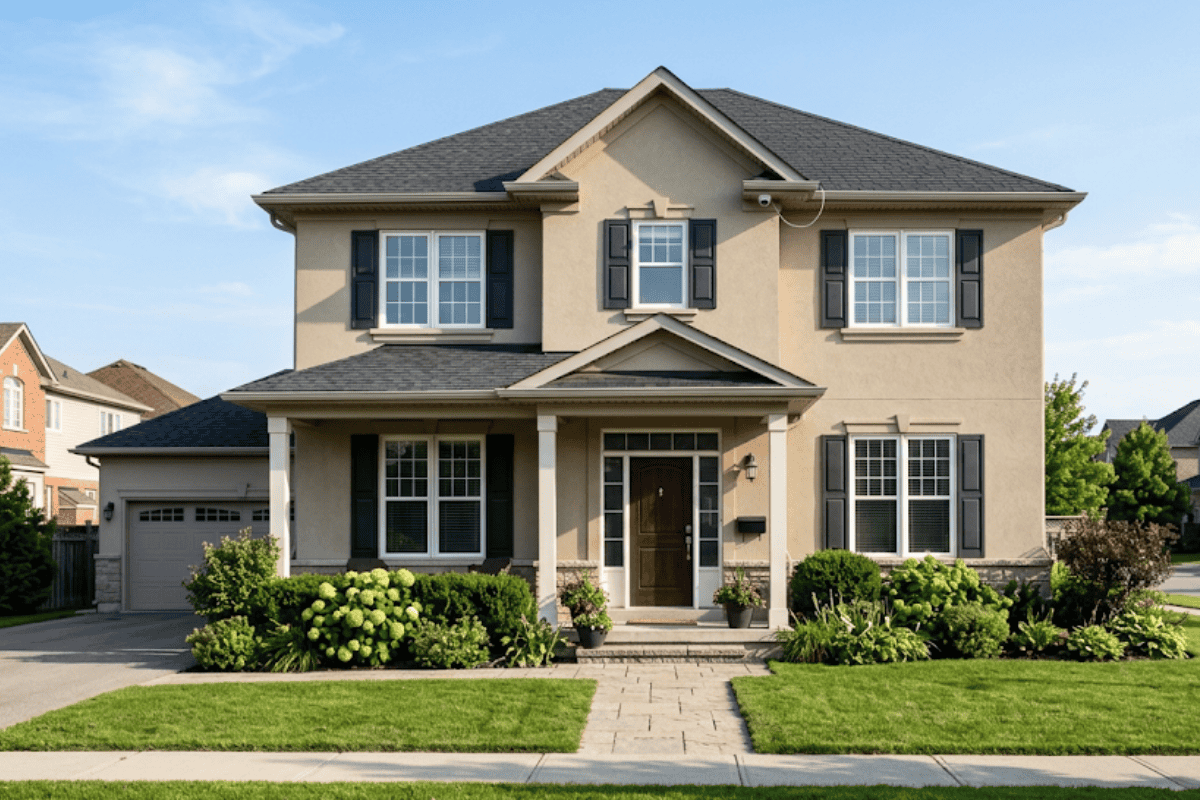
07 Sep Where Should Security Cameras Be Placed Outside a House? A Guide for Tulsa Homeowners
A homeowner in the Brookside area of Tulsa came home one evening last fall to find a package missing from the porch, even though a doorbell camera mounted above the garage, thirty feet away, had recorded nothing but an empty driveway the entire afternoon. That single gap is the most common mistake people run into when they start asking where should security cameras be placed outside a house: one camera pointed at one spot rarely covers a whole property. The porch, the driveway, the side gate, and a detached garage each create a separate sightline, and covering one of them does nothing to protect the other three.
Where Should Security Cameras Be Placed Outside a House for Full Coverage?
Most homes have four or five spots that matter more than the rest of the yard combined: the front entry, the driveway, the back door, any side gate or side yard, and a detached garage or shed if the property has one. Residential properties make up the large majority of burglary cases nationwide, and national crime data from the FBI shows residential break-ins accounted for nearly 63 percent of all burglary offenses in a recent reporting year. That figure lines up with what shows up on camera footage across Tulsa, Broken Arrow, Jenks, Bixby, Owasso, and Sand Springs: most attempted entries happen at a door or a ground-floor window, not through a roof or an upstairs window, which is exactly why door-facing coverage matters more than blanket yard coverage.
The front porch needs a camera that can see faces at the door, not just the top of someone’s head, so it should sit above head height but low enough to capture a clear angle on anyone standing at the entry. The driveway needs a wider field of view to pick up vehicles and license plates from the street to the garage. A back door or patio door is frequently the second most-used entry point, and it is also the one homeowners forget most often because it faces a fence line instead of the street. Side gates and narrow side yards are easy to overlook entirely, yet they are often the only path to a backyard, an AC unit, or a detached garage, which makes them a priority rather than an afterthought.
Camera Placement by Location: A Quick Reference
The table below lines up each priority zone with what it is meant to catch and the height and angle that tends to work best for that spot.
| Location | Purpose | Recommended Height & Angle |
|---|---|---|
| Front porch / entry door | Identify visitors and catch package deliveries or porch theft | 8 to 10 feet high, angled down toward the walkway |
| Driveway | Capture vehicles, license plates, and anyone approaching the house | 9 to 10 feet high, wide-angle lens covering the full driveway |
| Back door / patio | Cover a secondary entry point that is often left unmonitored | 8 to 9 feet high, angled toward the door and yard path |
| Side gate / side yard | Watch narrow access points between fences that are easy to miss | 8 to 9 feet high, angled along the fence line |
| Detached garage | Monitor a separate structure that stores tools, vehicles, or equipment | 9 to 10 feet high, corner-mounted for a wide field of view |
| Backyard / sliding doors | Oversee larger open areas and secondary glass entry points | 9 to 10 feet high, wide field of view angled across the yard |
Getting the Height and Angle Right
Height and angle decide whether a camera captures something usable or just a wide shot of the sky. A camera mounted at 8 to 10 feet on a front porch keeps the lens out of easy reach while still angling down enough to catch a face at the door, and that same range works for a back door or side gate. Driveway and garage cameras generally do better at 9 to 10 feet with a wider lens, since they need to cover distance rather than a single narrow entry point. One of the more common mistakes homeowners make, according to a breakdown of installation mistakes from NerdWallet, is hiding cameras so well that they no longer face the areas people actually walk through, which defeats the purpose of installing them in the first place.
A few other factors matter as much as the height and angle:
- Lens angle should point slightly downward toward the door or path, not straight out at eye level, so it captures a usable image of anyone approaching.
- Overlapping fields of view between two cameras close a gap that a single camera would leave open at a corner of the house.
- Weatherproof housing rated for Oklahoma’s mix of summer heat and winter ice keeps the camera functional year-round.
- Direct sunlight and glare from windows or pool water can wash out footage, so morning and afternoon sun angles are worth checking before mounting.
- Landscaping that looks fine today, like a young tree or shrub, can grow into the frame within a season or two.
This is also where natural sightlines come into play. Guidance on natural surveillance from crime prevention through environmental design, a framework used by police departments and city planners, points out that visibility and lighting around a property do as much to prevent crime as any single piece of equipment. A camera aimed at a dark, overgrown side yard will struggle no matter how good the lens is, so trimming sightlines and adding lighting alongside camera placement tends to produce better results than either step alone.
Local Layouts Across Tulsa, Broken Arrow, Jenks, Bixby, Owasso, and Sand Springs
Home layouts vary enough across the metro that a placement plan built for one property rarely transfers exactly to another. Midtown Tulsa neighborhoods like Brookside often have narrow side yards and alley access behind the house, which puts a gate or alley entrance ahead of the driveway on the priority list. Newer construction in Owasso and Bixby tends to include longer driveways and larger lots, so a driveway camera needs a wider field of view to reach from the street to the garage. Jenks and Broken Arrow have a mix of both, plus a fair number of detached garages and storage buildings set back from the main house that get missed entirely if every camera is aimed at the front of the property. Sand Springs properties on larger acreage often need a camera near a gate or entrance well before the house itself comes into view.
A few blind spots show up again and again once a property gets walked in person:
- Detached garages and workshops that sit outside the range of any camera mounted on the main house.
- Side yards behind privacy fences where a gate is the only way in or out.
- Elevated porches with deep roof overhangs that block a camera’s downward angle if it is mounted too far back.
- Long or curved driveways where a single fixed camera cannot see both the street and the garage door.
- Corner lots with two street-facing sides, which effectively double the number of approach angles a camera plan needs to account for.
Placement decisions like these come from research on how environmental design affects security outcomes, work that has shaped how police departments and security professionals think about sightlines, lighting, and camera coverage for decades. The same logic that applies to a commercial parking lot applies just as well to a driveway or a side gate at a house.
Why Choose Tulsa Surveillance Technologies
Working on properties across Tulsa, Broken Arrow, Jenks, Bixby, Owasso, and Sand Springs means seeing the same handful of layout problems repeat themselves in different neighborhoods. A driveway that curves behind a privacy fence in Jenks needs a different camera plan than a flat, straight driveway in Owasso. A side gate on a narrow midtown Tulsa lot behaves differently than a side yard on an acreage property outside Sand Springs. A detached garage set well back from the house in Bixby creates a blind spot that a single porch camera in Broken Arrow would never have to account for. Recognizing which of those situations applies to a given property, before any hardware goes up, is what separates a camera system that actually covers the entry points a home has from one that just covers the entry points a generic checklist assumes every home has.
That property-first approach carries through the residential security work done across the metro, from a single-camera porch setup to a full property plan covering a driveway, back door, side gate, and detached garage. Rather than mounting the same combination of cameras on every job, the process starts with walking the property, noting where porches, driveways, gates, and outbuildings create separate sightlines, and placing cameras so those sightlines overlap instead of leaving gaps between them.
Camera hardware matters too, and it works best when it is matched to where it is going. A wide dynamic range lens mounted at the correct height and angle will outperform a premium camera stuck in the wrong spot, so it helps to know what to look for before buying anything. This breakdown of home surveillance equipment covers the features that make the most difference for outdoor use in Oklahoma’s weather.
Lighting plays a supporting role that is easy to underestimate. Guidance from the National Crime Prevention Council on home safety recommends lighting up any space where someone could linger unseen, including gaps between trees or shrubs, entryways, and side yards. Pairing that kind of lighting with a camera aimed at the same spot gives both a usable image at night and one less place for anyone to stand without being seen.
Conclusion
Answering where should security cameras be placed outside a house comes down to identifying every point where someone could approach the property unseen, not just the front door. A porch camera that misses the driveway, a driveway camera that misses the side gate, or a garage camera that misses the back door all leave a real gap, even if the rest of the system looks complete on paper. Height, angle, lighting, and the specific layout of a property in Tulsa, Broken Arrow, Jenks, Bixby, Owasso, or Sand Springs all factor into getting that coverage right the first time. If the current setup covers the driveway but leaves the side gate dark, or watches the porch while ignoring a detached garage, reach out to Tulsa Surveillance Technologies to walk through the property and close those gaps.
Ready to schedule your free consultation and map out your home’s camera coverage?
Frequently Asked Questions
What is the best height to mount an outdoor security camera?
Most outdoor cameras work best mounted 8 to 10 feet off the ground. This range keeps the camera out of easy reach while still low enough to capture a usable image of a person’s face rather than just the top of their head.
How many outdoor cameras does a typical house need?
Most single-family homes need four to six cameras to cover the front entry, driveway, back door, and any side gate or detached garage. The exact number depends on the size of the lot and how many separate access points the property has.
Should outdoor security cameras be visible or hidden?
Outdoor cameras generally work better when they are visible rather than hidden. A camera someone can see before attempting to approach a house serves as a deterrent, while a hidden camera only provides footage after the fact.
What angle should outdoor cameras be positioned at?
Cameras should be angled downward and slightly to the side of a door or walkway rather than pointed straight out at eye level. This angle captures a clearer, more identifiable image of anyone approaching the entry point.
Which entry points around a house are most important to cover with cameras?
Front, back, and side doors are the most important, since they are the most commonly used entry points in residential break-ins. Driveways, side gates, and detached garages come next, since they are frequently overlooked but still provide direct access to the property.
Sorry, the comment form is closed at this time.